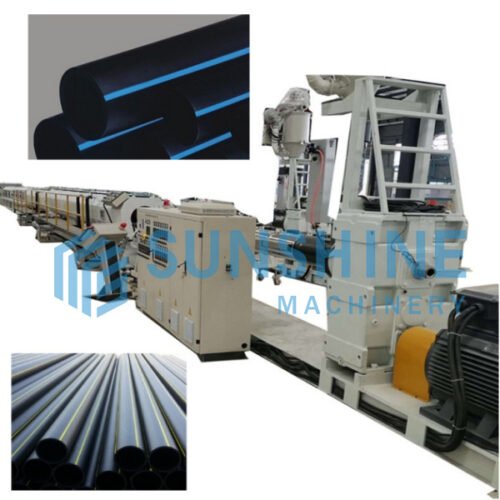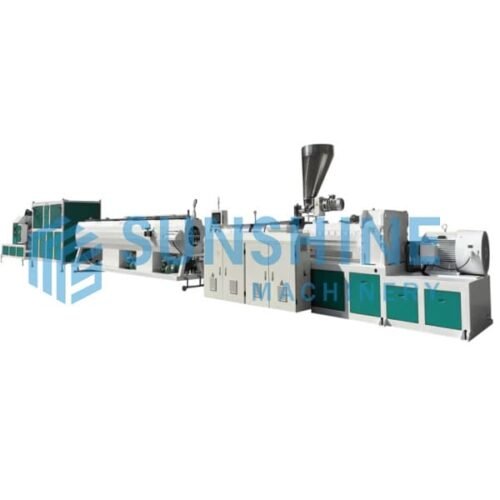

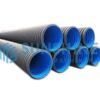
Let us introduce the Double Wall Corrugated Pipe Making Machine to you.
What Is Double Wall Corrugated Pipe Making Machine?
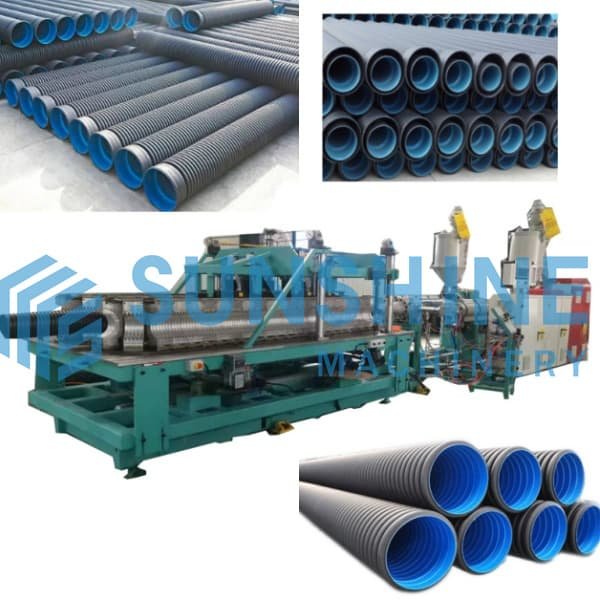
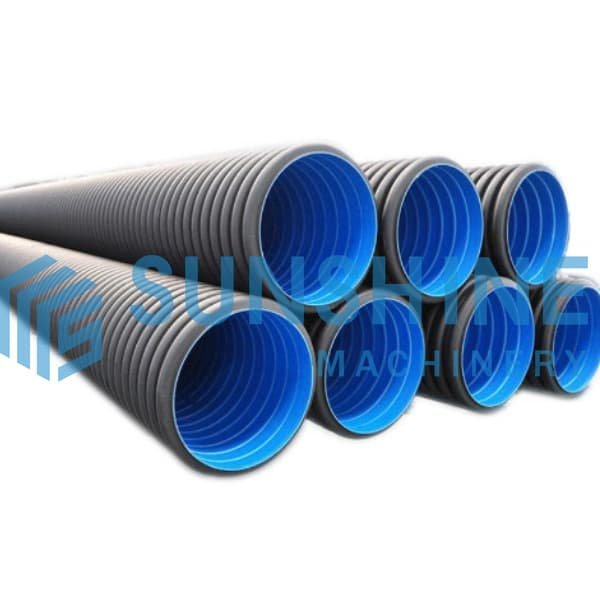
Double Wall Corrugated Pipe Making Machine is a high-end plastic machinery that uses two extruders to co-extrude pipes with smooth inner walls and corrugated outer walls.
What are the components of machine?
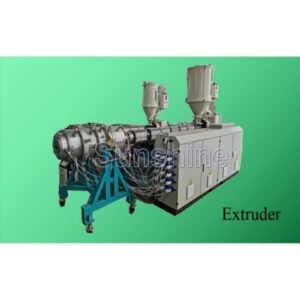
Dual-extrusion system: Typically consists of two extruders (single-screw or counter-rotating twin-screw), one extruding the inner flat wall layer and the other extruding the outer corrugated layer.
Dual-layer co-extrusion die head: The core component, ensuring precise bonding of the inner and outer molten plastic layers before entering the molding machine, guaranteeing interlayer adhesion strength.
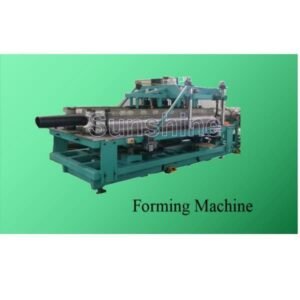
Vertical/horizontal molding machine: Equipped with a complete set of circulating aluminum alloy modules, extruding the outer layer into a corrugated shape through vacuum adsorption or pneumatic forming.
Online flaring system: Directly flares the pipe end (socket joint) during the molding process, eliminating the need for secondary processing and improving sealing performance.
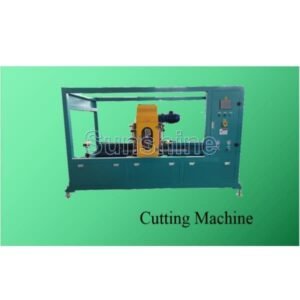
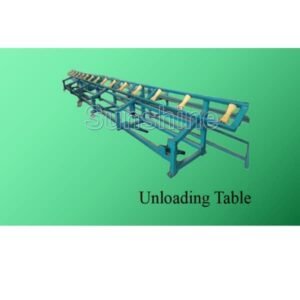
Fully automatic cutting and stacking machine: Ensures a clean cut through planetary or hydraulic cutting and automatically collects the finished product.
What are the technical features of machine?
High Ring Stiffness and Lightweight:
The unique “I-beam” structure saves 30%-50% of raw materials compared to solid-wall pipes while maintaining the same compressive strength (ring stiffness).
Vacuum Forming Process:
Modern high-end production lines mostly use vacuum forming, resulting in full corrugations, uniform wall thickness, and faster production speeds.
Sealed Water-Cooling Circulation:
The forming mold typically has an efficient water circulation cooling system, ensuring continuous high-speed production 24 hours a day.
Automated Control:
Utilizing PLC touchscreen control, it achieves full-line synchronization and one-button parameter adjustment.
What are the application areas of pipes?
Due to its “rigid exterior and flat interior” characteristics, it is mainly used in large-scale projects:
Municipal Engineering: Urban rainwater drainage, domestic sewage collection and transportation.
Power and Telecommunications: Underground protective pipes for high-voltage cables and optical fibers.
Transportation Engineering: Seepage and drainage pipes for railways and highways.
Agricultural Irrigation: Irrigation and drainage systems for farmland, orchards, and forest belts.